Choosing a Lithium Ion Battery Pack is not just a matter of comparing voltage or price. Buyers need to understand how pack design affects installation, service life, and everyday performance. Cylindrical, prismatic, and pouch cells each offer different trade-offs in shape, cooling, and packaging. The best fit depends on the device, available space, expected load, and operating conditions. Small details matter. A pack that fits neatly in a drawing may be harder to cool or replace in the field.
This guide introduces common battery pack types and the practical questions buyers can ask suppliers. It considers capacity, rated voltage, battery management systems, thermal control, enclosure design, and documentation. These details help buyers compare offers beyond the headline specifications. Ask how performance is measured, what protections are built in, and whether test data matches your intended use. A clear datasheet is useful, but it cannot answer every question about real-world conditions. That is worth remembering. No format is best for every application, and published figures may vary with temperature, discharge rate, and pack configuration. Careful comparison can narrow the options, but buyers should verify specifications with the manufacturer before making a decision.
A lithium-ion battery pack is more than a row of cells. Cells connect in series to raise voltage and in parallel to increase capacity. A battery management system monitors temperature, voltage, and current, helping prevent damaging operating conditions. It cannot compensate for poor pack design. Buyers should compare usable energy in kilowatt-hours, continuous power in kilowatts, operating temperature, and expected cycle life. These figures describe different things.
Chemistry affects weight, cost, and performance. Lithium iron phosphate packs often prioritize long service life and thermal stability, while nickel-rich chemistries commonly offer higher energy density. Neither label alone predicts real-world suitability. Check the manufacturer’s test conditions and warranty assumptions.
The International Energy Agency reported that electric-vehicle battery demand reached about 750 gigawatt-hours in 2023, showing how rapidly pack technology is scaling.
BloombergNEF reported an average lithium-ion pack price of $139 per kilowatt-hour in 2023, 14% lower than in 2022.
Still, price per kilowatt-hour can obscure differences in usable capacity, cooling, and serviceability. A compact pack may fit neatly beneath a floor, yet its performance can shift in cold weather.
Details matter.
In 2026, lithium-ion packs most often use lithium iron phosphate (LFP), nickel manganese cobalt (NMC), or nickel cobalt aluminum (NCA) chemistry. LFP generally offers strong cycle life and good thermal stability, with less energy stored per unit of weight. That trade-off matters in a delivery van, where payload and driving range compete. NMC and NCA typically provide higher energy density, making them useful when space and weight are tight. Their performance depends on cell design, pack cooling, and battery management—not chemistry alone.
There is no universal winner. Not even close. A home storage system may favor LFP’s long service life, while a compact vehicle may benefit from an energy-dense pack. Buyers should compare usable capacity, warranty terms, charge limits, and performance in local temperatures. Ask for test conditions behind any cycle-life figure; a number without its temperature and depth of discharge tells only part of the story.
Sodium-ion packs are also appearing in some applications, though availability and energy density vary. They are not lithium-ion chemistry, but buyers may encounter them alongside lithium options. The comparison is not perfectly neat: real-world results can differ between cells and pack designs. Check the complete system specification, rather than choosing by chemistry label alone.
| Battery Chemistry | Typical Cell Voltage | Indicative Cell-Level Energy Density | Typical Cycle-Life Range | Key Strengths | Trade-Offs | Common Applications |
|---|---|---|---|---|---|---|
| LFP (Lithium Iron Phosphate) | About 3.2 V nominal | Approximately 90–160 Wh/kg | About 2,000–6,000 cycles | Strong thermal stability; long service life; does not use nickel or cobalt in the cathode. | Lower energy density than many nickel-rich chemistries; performance can be more affected by cold temperatures. | Electric vehicles, stationary energy storage, commercial vehicles, and other applications prioritizing longevity and safety. |
| NMC (Lithium Nickel Manganese Cobalt Oxide) | About 3.6–3.7 V nominal | Approximately 150–250 Wh/kg | About 1,000–2,000 cycles | Balanced energy density, power capability, and cycle life; available in a range of nickel-to-manganese-to-cobalt blends. | Contains nickel and cobalt; cycle life and thermal behavior depend on cell design, blend, and operating conditions. | Electric vehicles, power tools, e-bikes, and portable energy systems. |
| NCA (Lithium Nickel Cobalt Aluminum Oxide) | About 3.6–3.7 V nominal | Approximately 200–260 Wh/kg | About 500–1,500 cycles | High energy density and good specific power in designs optimized for those characteristics. | Contains nickel and cobalt; careful thermal and charge management is important, and cycle life varies substantially by design. | Long-range electric vehicles and applications where stored energy per unit mass is a priority. |
| LCO (Lithium Cobalt Oxide) | About 3.6–3.7 V nominal | Approximately 150–200 Wh/kg | About 500–1,000 cycles | High energy density in compact cells. | Contains cobalt; generally has a shorter cycle life and requires careful protection against overheating and overcharging. | Phones, laptops, cameras, and other portable electronics. |
| LMO (Lithium Manganese Oxide) | About 3.7–4.0 V nominal | Approximately 100–150 Wh/kg | About 500–1,500 cycles | Can provide good power output; manganese-based cathodes can reduce reliance on cobalt. | Typically offers less energy density and cycle life than some alternatives; often blended with other chemistries. | Power tools, medical devices, and some electric-vehicle or hybrid applications. |
| LTO (Lithium Titanate) | About 2.3–2.4 V nominal | Approximately 50–100 Wh/kg | About 5,000–20,000 cycles | Very long cycle life; supports fast charging and strong power output; performs well across a broad temperature range. | Lower cell voltage and energy density mean a larger, heavier pack may be needed for a given amount of stored energy. | Fast-charge transport, high-cycle industrial systems, and applications requiring long service life. |
Figures are indicative ranges for lithium-ion cells, not guaranteed specifications for complete battery packs. Actual energy density and cycle life vary with cell format, materials, pack design, temperature, charge rate, depth of discharge, and end-of-life criteria. Pack-level energy density is generally lower than cell-level energy density.
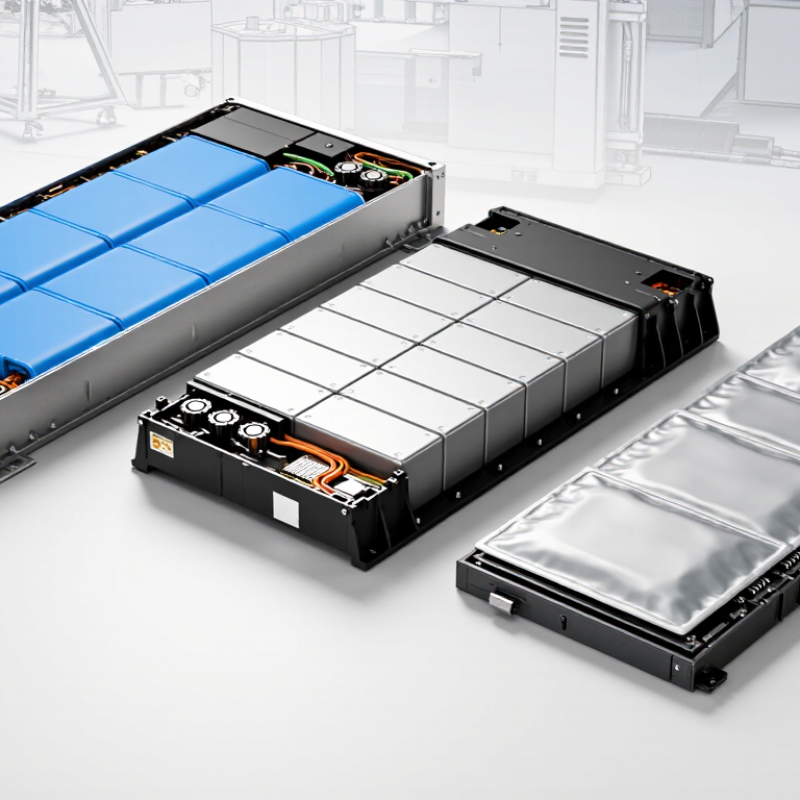
Lithium-ion battery packs differ not only in capacity, but also in cell shape and internal structure. Cylindrical cells are sturdy, repeatable, and relatively easy to arrange in rows. Their rounded sides leave small gaps, so the pack may need extra support or careful spacing. Prismatic cells use flat, rigid cases. They can make better use of rectangular enclosures, but their size and swelling behavior require thoughtful restraint. Pouch cells are light and flexible in shape. They need firm compression and protection from punctures. Small details matter.
Pack structure affects assembly, cooling, repair, and the space available for wiring. A module-based design groups cells into smaller units, which can simplify handling and inspection. A cell-to-pack layout removes some intermediate structure and may save space, though it can make service more involved. Neither format wins in every application. Real enclosure dimensions, operating temperatures, vibration, and maintenance plans should guide the choice. It is easy to overestimate usable space on a drawing; leave room for insulation, connectors, and safe clearances.
Tips: Ask suppliers for cell dimensions, pack drawings, thermal limits, and cycle-life test conditions. Compare complete pack weights, not cell weights alone. Check how damaged cells can be isolated and whether routine inspection is practical. A compact pack can look ideal, until a connector cannot be reached.
Choosing a lithium-ion battery pack starts with the job it must do.
Cylindrical cells suit many power tools and portable equipment because their rigid cases handle routine vibration well. They are familiar to pack builders, too. Pouch cells are lightweight and can fit thin devices, but their soft outer layers need firm support and careful protection from swelling. Prismatic cells use a hard, rectangular case. Their shape can simplify layouts in floor-cleaning machines or larger storage cabinets. Shape matters. Still, cell format alone does not determine performance; chemistry, controls, and pack design matter just as much.
For stationary backup or daily energy storage, lithium iron phosphate packs are often considered for their long cycle life and stable thermal behavior.
Their lower energy density may require more installation space. Electric mobility applications can favor higher-energy chemistries when range and weight are priorities, though heat control and charging limits need close attention. Match the pack to actual duty: peak current, operating temperature, vibration, available space, and expected cycles. Ask for test data at the intended load, not just a headline capacity. Even careful sizing can miss real-world conditions, such as cold starts or repeated short trips. The best fit is not always the smallest pack.
2026 Top Lithium Ion Battery Pack Types for Buyers
Choosing a battery pack means balancing safety, cost, lifespan, and performance—not chasing one headline number. Lithium iron phosphate (LFP) packs often suit buyers who value long cycle life and thermal stability. Nickel-rich NMC and NCA packs can store more energy in a smaller, lighter space, which helps when weight or range matters. No chemistry is risk-free. Cell quality, pack construction, cooling, and battery management also affect safety.
Lithium titanate (LTO) packs can handle frequent cycling and fast charging, but their lower energy density and higher purchase cost may not suit every project. Compare the full ownership cost, not just the quoted price. Ask about usable capacity, warranty conditions, and expected cycle life under your actual temperature and charging routine. A published cycle figure may assume gentle use. That detail is easy to overlook.
Tips: Request test data for the complete pack, not only individual cells. Check the warranty. Match the pack’s discharge rating to your equipment’s peak load, and leave room for seasonal temperature changes. If two options seem nearly equal, revisit your assumptions: a lighter pack may cost more, while a cheaper pack may need earlier replacement.