How to Choose Solar Installation Services for Your Business?
Choosing solar for a business is not just a matter of comparing panel prices. The right system must fit your roof, energy use, operating hours, and plans for the property. A warehouse with broad, unshaded roof space has different needs from a shop with limited space and high daytime cooling costs. Details matter. Even the location of rooftop equipment can affect design and installation.
Reliable solar installation services should explain how they assess these details, estimate expected production, and plan the work around your business. Ask for a site review, a clear proposal, and an explanation of assumptions behind projected savings. Check the installer’s relevant experience, credentials, insurance, references, and warranty support. Then compare proposals on more than price. Look closely at equipment specifications, project timelines, maintenance options, and how the system connects to your existing electrical setup. A glossy estimate is not proof of a sound design.
There is no single best system for every business. Energy bills, roof condition, shading, and future expansion can change the answer. Some figures may also depend on weather and actual operating patterns, so estimates should not be treated as guarantees. That part is easy to overlook. It deserves a second look. This guide outlines practical questions to ask, warning signs to notice, and factors to weigh before selecting an installer. The goal is a decision you can explain to your team, supported by clear documentation rather than confident sales language.
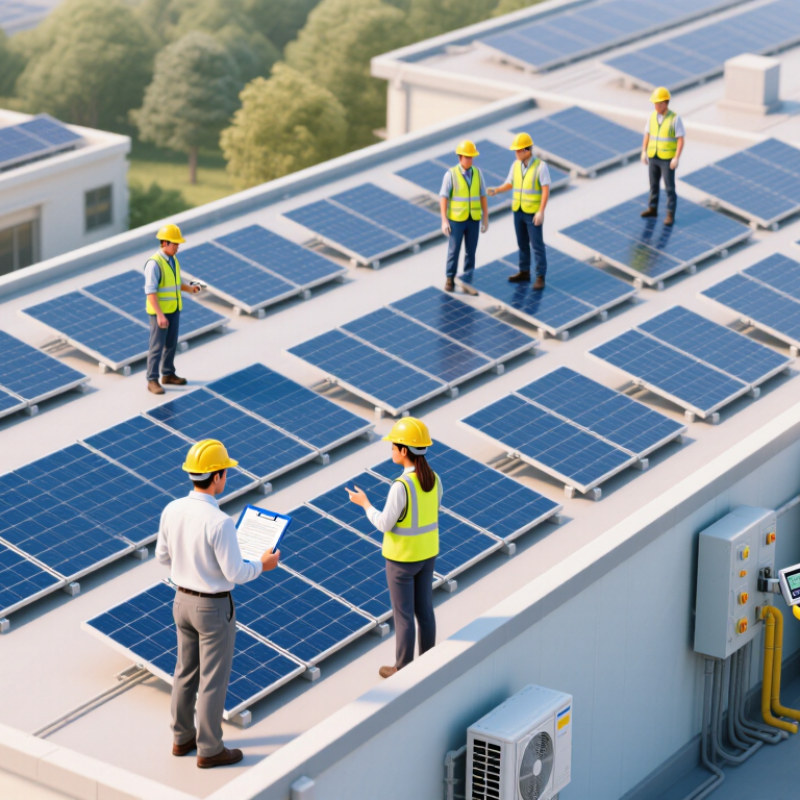
Assess Business Energy Use and Site Potential Before Sizing a Solar System
Choosing solar installation services starts with evidence, not a panel count. Export at least 12 months of interval electricity data, preferably 15-minute records. Include tariffs, demand charges, operating hours, and planned equipment changes. The U.S. Energy Information Administration’s 2018 Commercial Buildings Energy Consumption Survey shows that commercial energy loads vary by building activity. Lighting, cooling, ventilation, and refrigeration create different demand patterns. A monthly bill can hide an expensive afternoon peak. It often does.
A qualified installer should model hourly production against hourly consumption. NREL’s PVWatts documentation uses a default 14% total system-loss assumption. This includes wiring, inverter, and mismatch losses. Local shading can make that assumption optimistic. Walk the roof at different times, inspect drains and roof age, and verify structural capacity. The roof is not just empty space. Measure orientation, tilt, nearby trees, and future construction. Request irradiance assumptions and calculation files, not only an annual kilowatt-hour promise.
System size should reflect usable energy, export rules, backup goals, and cash flow. Oversizing may increase surplus electricity without improving economics. Undersizing may leave demand charges untouched. IEA PVPS reported global photovoltaic capacity above 1.4 terawatts at the end of 2023, yet global scale cannot guarantee a strong local project. NREL research by Jordan and Kurtz cites median module degradation near 0.5% annually. That estimate is useful, but not universal. Require production ranges, degradation assumptions, maintenance access, and clear correction terms. I would revisit the design after one year of interval data; real behavior often disagrees with the first model.
Verify Installer Credentials and Experience Against SEIA Consumer Guidance
Choosing a commercial solar installer starts with evidence, not a polished proposal. SEIA’s consumer guidance recommends checking licensing, insurance, references, and documented experience. Ask for the electrical contractor’s license number and verify it with the relevant state or local authority. Request certificates of insurance, recent business-project references, and details of who will perform the installation. Subcontracting is common, but the people on your roof should not be a mystery.
Ask for comparable projects. A warehouse roof, for example, has different structural and access needs than a small office. Request photos, system sizes, and permission to contact the property owners. Check whether the proposal explains equipment, production estimates, roof penetrations, warranties, and maintenance responsibilities. Read the assumptions carefully. A sales estimate is not a guarantee. SEIA and Wood Mackenzie reported that the United States added 50 gigawatts of solar capacity in 2024, showing how quickly the industry is growing. Growth does not prove an individual contractor’s quality.
Get at least three written bids, as SEIA advises, and compare scope rather than headline price. Ask who handles permits, utility coordination, inspections, and service calls. Confirm that promised workmanship coverage appears in the contract. Small omissions matter. I would also ask for a project schedule with named contacts; even a capable installer can communicate poorly, and that risk deserves a candid conversation.
Compare System Costs with IRENA’s 2023 Solar LCOE Benchmark of $0.044/kWh
How to Choose Solar Installation Services for Your Business?
IRENA’s 2023 benchmark puts the global weighted-average levelized cost of electricity from newly commissioned utility-scale solar at about $0.044/kWh. Treat that figure as a reference, not a promised price for your business. It reflects large projects and broad market data. A rooftop system may cost more per kilowatt-hour because of roof work, financing, local labor, and smaller scale.
Ask installers to show their assumptions. Compare the full system cost, expected annual generation, maintenance, inverter replacement, and financing over the same period. Check whether estimates account for shading from vents, winter production, and your actual daytime electricity use. A clear proposal should separate equipment and installation costs from projected savings. Small details matter.
Request evidence of similar commercial projects and ask who handles permits, inspections, and ongoing service. Verify warranties in writing, and have an independent professional review production estimates if the investment is substantial. One flaw: forecasts can look precise while weather and energy prices remain uncertain. Leave room for that uncertainty. A low bid alone tells you little.
How to Choose Solar Installation Services for Your Business?
Compare utility-scale solar photovoltaic electricity costs with IRENA’s 2023 global weighted-average LCOE benchmark of $0.044/kWh.
IRENA reported a global weighted-average solar PV LCOE of $0.049/kWh in 2022 and $0.044/kWh in 2023. When evaluating installation proposals, compare the projected project LCOE with this benchmark while also reviewing system size, expected generation, financing, maintenance, and site conditions.
Review Equipment Warranties and NREL’s 0.5% Median Annual PV Degradation Rate
When choosing solar installation services for a business, examine warranties beside projected energy output. NREL’s analytical review found a median photovoltaic degradation rate of 0.5% per year. Its dataset covered more than 2,000 degradation rates from approximately 2,000 systems. At that rate, a system could retain about 88% of its original output after 25 years. This is a statistical median, not a promise.
Read the exclusions. Performance warranties should state annual loss limits, measurement conditions, and claim procedures. Check whether the warranty covers labor, transport, replacement, and system removal. Confirm its transferability if the property changes ownership. IEA PVPS Task 13 reports emphasize that moisture, thermal stress, and installation defects can accelerate module failures. Therefore, a long warranty is weak protection if the installer avoids responsibility for site conditions.
Ask the installer to model degradation using your roof’s heat, dust, shading, and maintenance schedule. A spreadsheet can look precise, yet a dusty roof is not a laboratory. I would also compare the warranty’s starting power tolerance with the expected first-year loss. That detail is easy to miss. Request sample test reports, commissioning records, and a written escalation process. The cheapest offer may still produce higher lifetime costs when inspections, labor, or delayed claims are excluded.
Check Permits, Grid Interconnection, Project Timelines, and Ongoing Maintenance
How to Choose Solar Installation Services for Your Business?
A reliable solar installer should explain every permit before construction begins. Local building, electrical, fire, and land-use approvals may all apply. Ask who prepares the documents and who communicates with inspectors. Missing one approval can delay equipment delivery or create expensive rework. An experienced contractor should also review your roof condition, electrical capacity, and future expansion plans. I have learned that a low installation price means little without clear responsibility.
Grid interconnection deserves equal attention. The installer should confirm utility requirements, application fees, protection settings, and export limits in writing. Ask for a realistic project timeline, including design, permitting, equipment delivery, inspections, and utility approval. A perfect schedule is rarely realistic. Weather, transformer capacity, or incomplete paperwork can change it. Request milestone updates and define what happens when the first estimate proves wrong.
Tips: Keep copies of permits, drawings, utility correspondence, and inspection reports. Ask for a maintenance plan covering panel cleaning, inverter checks, monitoring alerts, and emergency support. Clarify response times and replacement procedures before signing. Choose measurable service commitments, not vague promises. A quarterly performance review can reveal small output losses before they become costly. Do not ignore maintenance. Even a well-designed system needs attention.